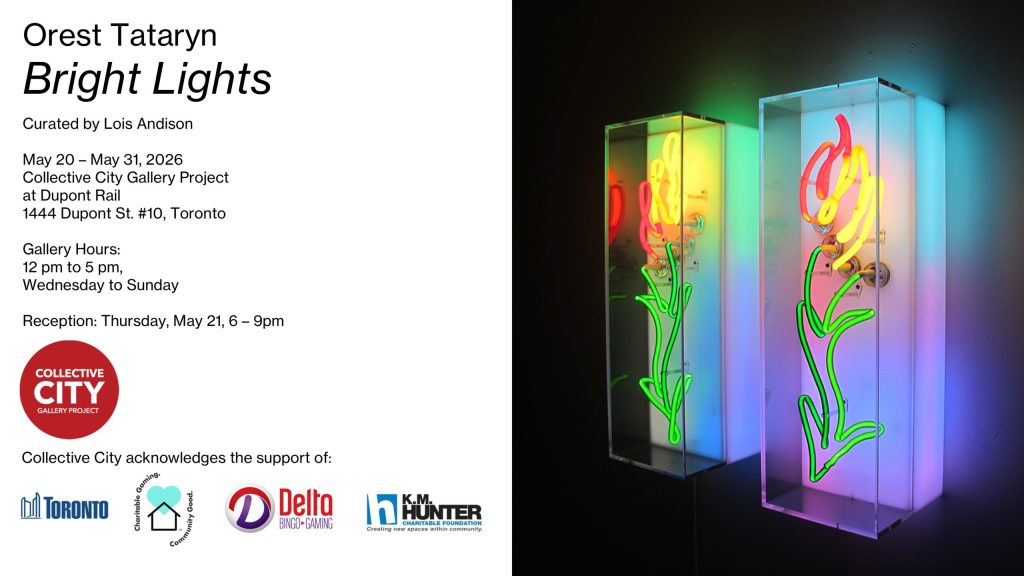
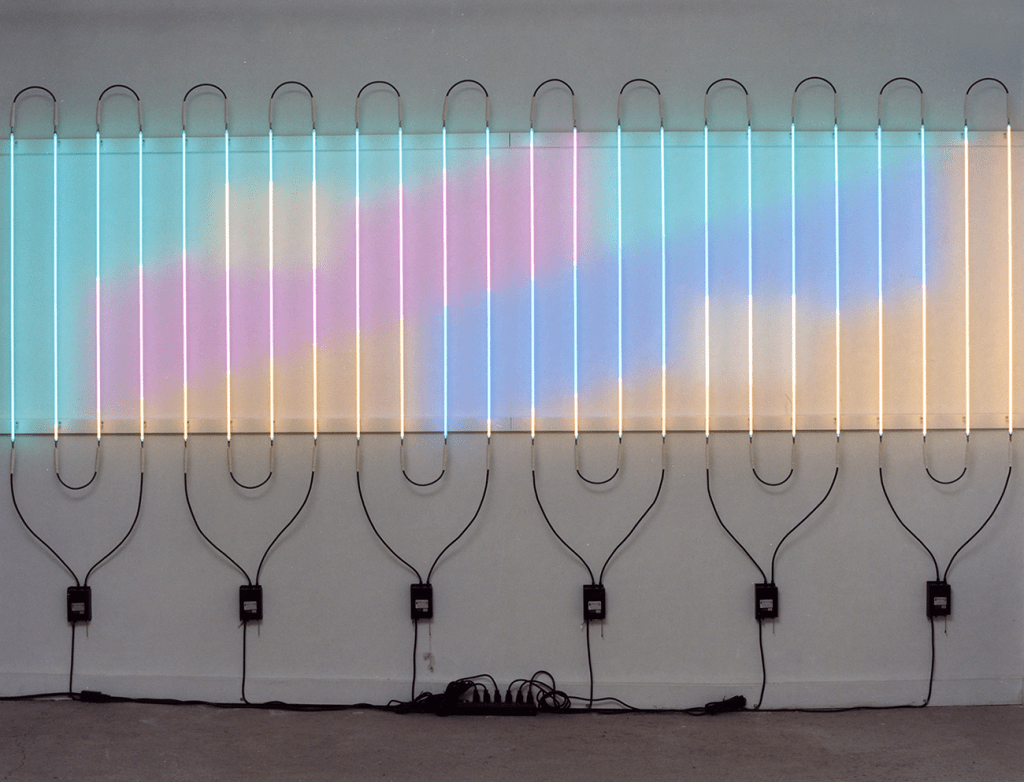
A colourist at heart, Orest’s signature works are colour studies that combine mathematics with pattern, abstraction, and the precise placement, proportions, and relationships of chroma. His process often involves cutting sections of glass tube (some phosphor-coated and uncoated coloured glass), then fusing the different sections, then repeating this technique with minor variations over a number of tubes to create
a colour field. The proposed exhibition will present both large-scale works and smaller works, many of which are undocumented. What is presented in the images is representative of the span of his practice but does not fully reflect what will be exhibited.



shine on, 2026
text by lois andison
shine on is an exhibition of a selection of Orest Tataryn’s light sculptures, serving as a tribute to both the artist and the dying art of neon.
closing shop
After 35 years in the field, Orest closed his neon studio, neonisoris, due to health reasons.
Although he had contended over the years that he was not an artist because he had not attended art school, one only had to step into his shop to realize he was downplaying his artistic contributions. The place was a symphony of glass in all stages of rest, development, and transformation, and a testament to the various life paths that intersected—his day job as a firefighter, the collective he was part of, Skunkworks – Outlaw Neon, the neon he fabricated for other artists, and his personal work.
Orest bought the house on Westminster Avenue because of the garage, which was to become home to his neon studio. Everything, including running a gas line, was done without permits in true Skunkworks – Outlaw neon fashion…“It’s easier to ask forgiveness than to ask (get) permission.” The sturdy cinder block building suited the activity, but even with the fires going, the winter cold seeped up through the floor, slightly mitigated by foam insulation duct-taped to the bottoms of boots. To say that the shop was full is an understatement. Even I was unaware of how prolific he was. Perhaps it is the impulse to hold on to the past, but I wish that we had photographed the studio before dismantling it.
what makes neon neon
Neon is a noble gas, and as Coley, a fellow devotee, put it, working in neon often feels like performing magic. It is a process that demands technical skill, patience, and luck—either it works, or it doesn’t. You begin by drawing the pattern in reverse, selecting the glass tube diameter and colour, and deciding whether to use neon or argon gas. Using a string, you measure the pattern’s path to calculate how much glass you need. Next, you use equipment like cross burners, ribbon burners, and hand torches to heat, bend and fuse the glass. After shaping the tube, electrodes are welded to each end. The tube is attached to the vacuum manifold to extract contaminants. While the vacuum pump is running, the bombarder sends electricity (up to 50,000 volts) through the evacuated tube, making the glass extremely hot. The switch that activates this high-voltage process is called the ‘dead-man switch’—not for the faint of heart.
Like many specialized fields that involve the skill of the hand, neon is a dying craft. Searches for neon signs will direct you to LED sign companies. For me, an LED sign is an impersonator—the fragility, dimensionality, pulse, breath, danger, and craftsmanship are all missing.
the works in the show
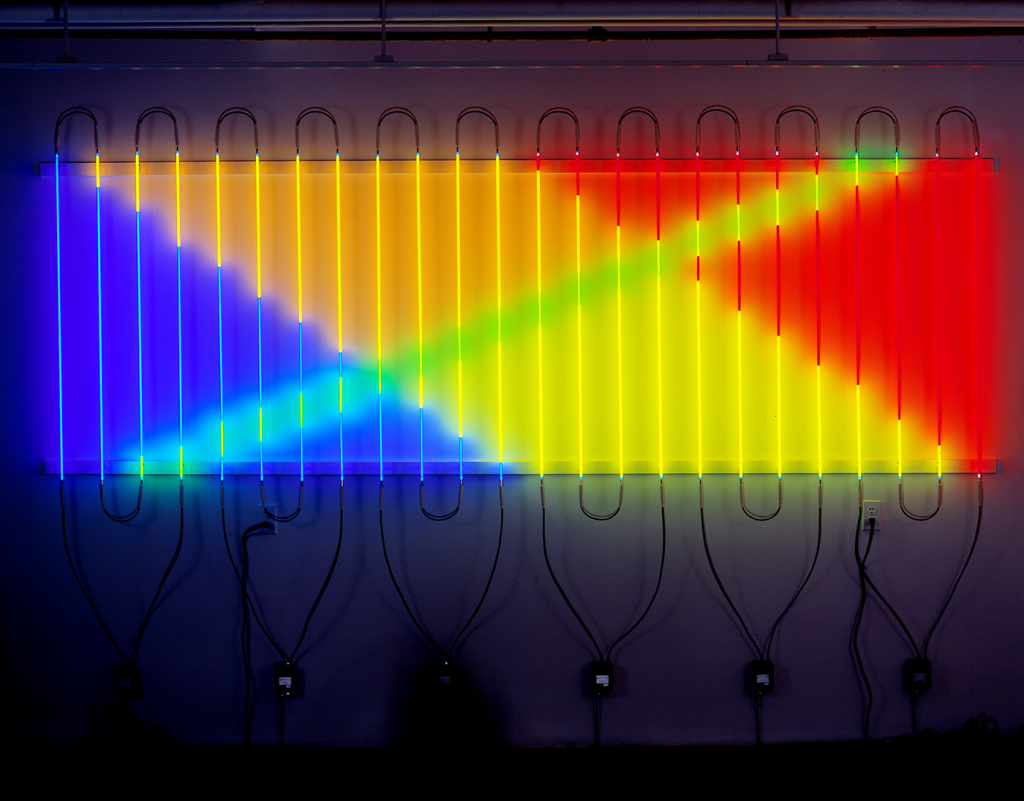
As many works in this show reveal, Orest is a colourist at heart. His signature works are colour studies combining mathematical principles such as the Fibonacci sequence and the golden ratio with pattern, abstraction, the precise placement, and relationships of chroma. His process often involved cutting sections of glass tubes (some phosphor-coated and some uncoated, some coloured, and some clear), fusing the sections, and repeating the process with minor variations across multiple tubes. When the work is wired and installed, the light washes the wall with soft diffused colour that blends to create a colour field (a term associated with abstract expressionist painting). Orest often numbered these colour fields #1, #2…#23. I personally regard them as colour studies, for as much as they are planned, there is something experimental and intuitive in this approach to neon.
Other works in the show reflect Orest’s irreverent sense of humor, often sparked by daily observations and mimetic play. For example, he found ideas in graffiti like “apathy kills” with “who cares” spray-painted over it. While ohio christ was not an intentional lift, he later discovered “OHIO” spray-painted on a local fence—the sequence is unimportant. This piece is a favorite of mine, not for religious reasons, but for the symmetry in the text, the simplicity yet fullness of the font, and the mirroring that forms a cross. Here, the neon sits behind the cut acrylic, creating a backlit effect.
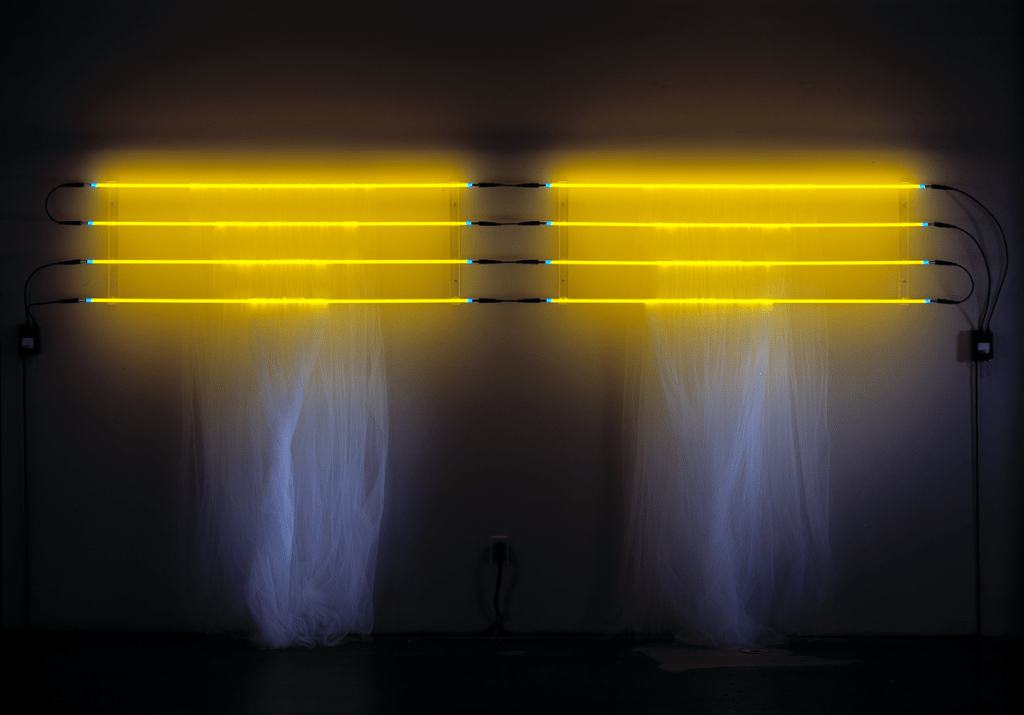
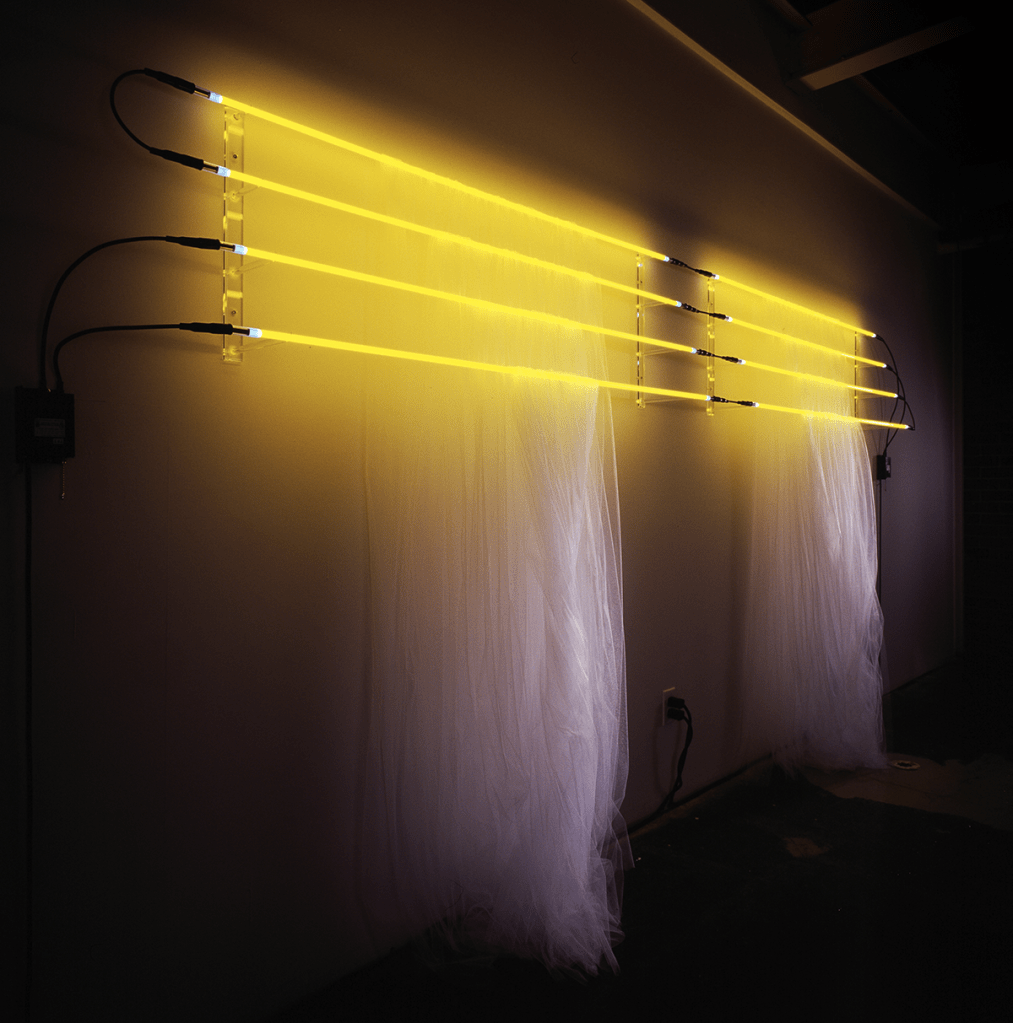
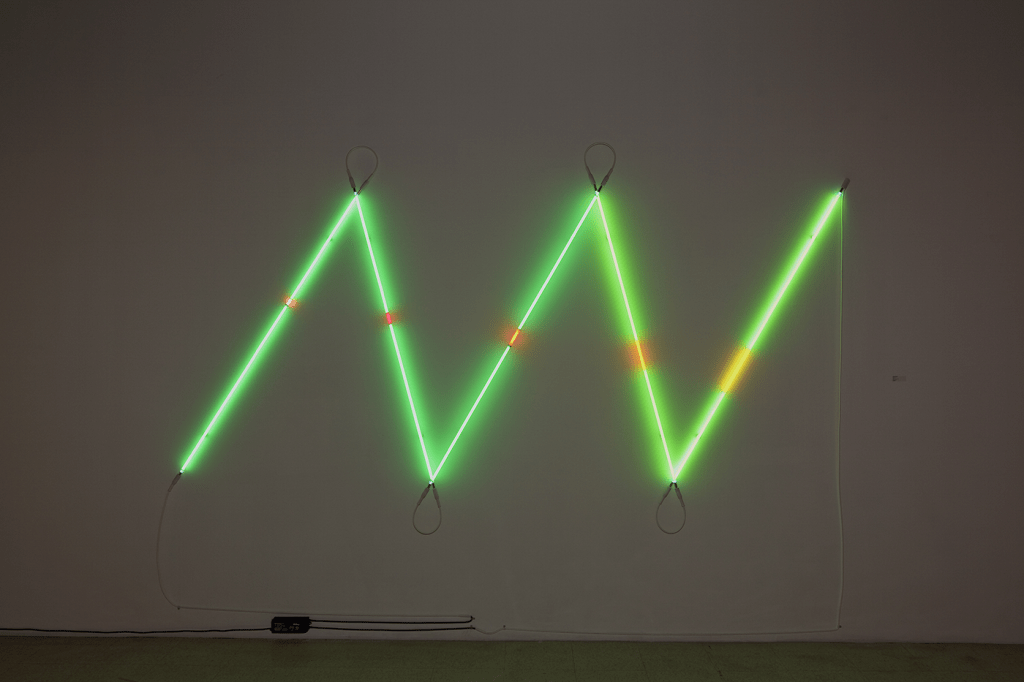
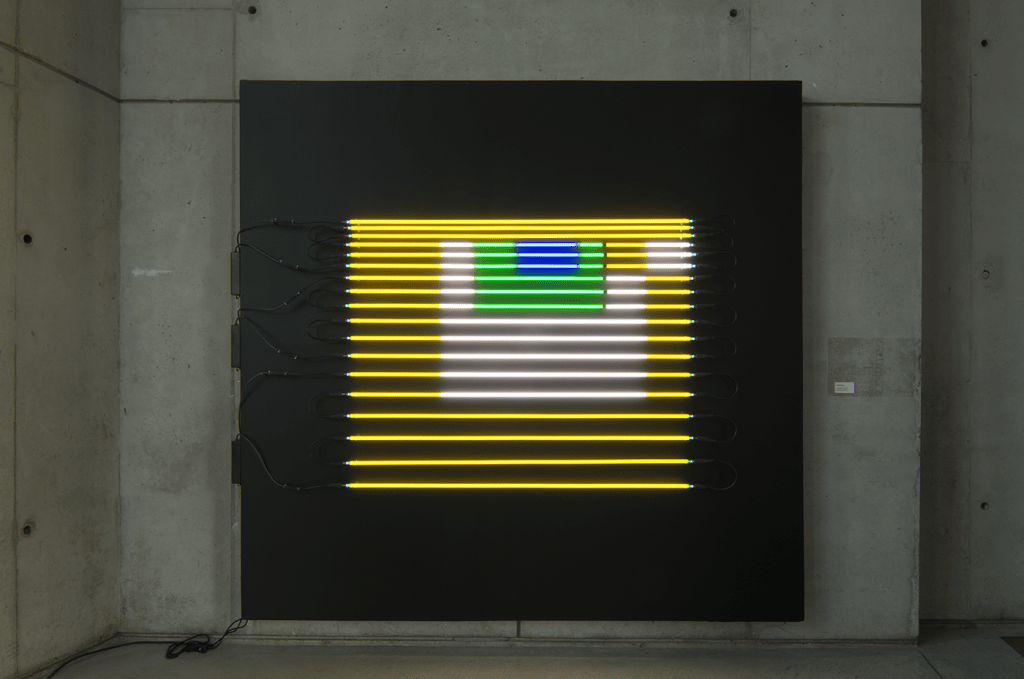
Not sure if you would immediately register envy when you look at NV unless you said the letters out loud. There is something delightful about envy being outfitted in such a rich emerald green, punctuated by complementary notes. The piece is striking for its dramatic italic form marching to its own beat. On the other side of envy, metaphorically, is yellow waterfall. The installation is one of Orest’s earliest large-scale works. Even though the yellow is slightly acidic, the piece has a poetic softness and gentleness. It is elegant in its cascading presentation. colour field # 23 also prioritizes yellow but not with the same emotional intensity. This colour field feels more analytical and abstract and perhaps comes the closest to painting.
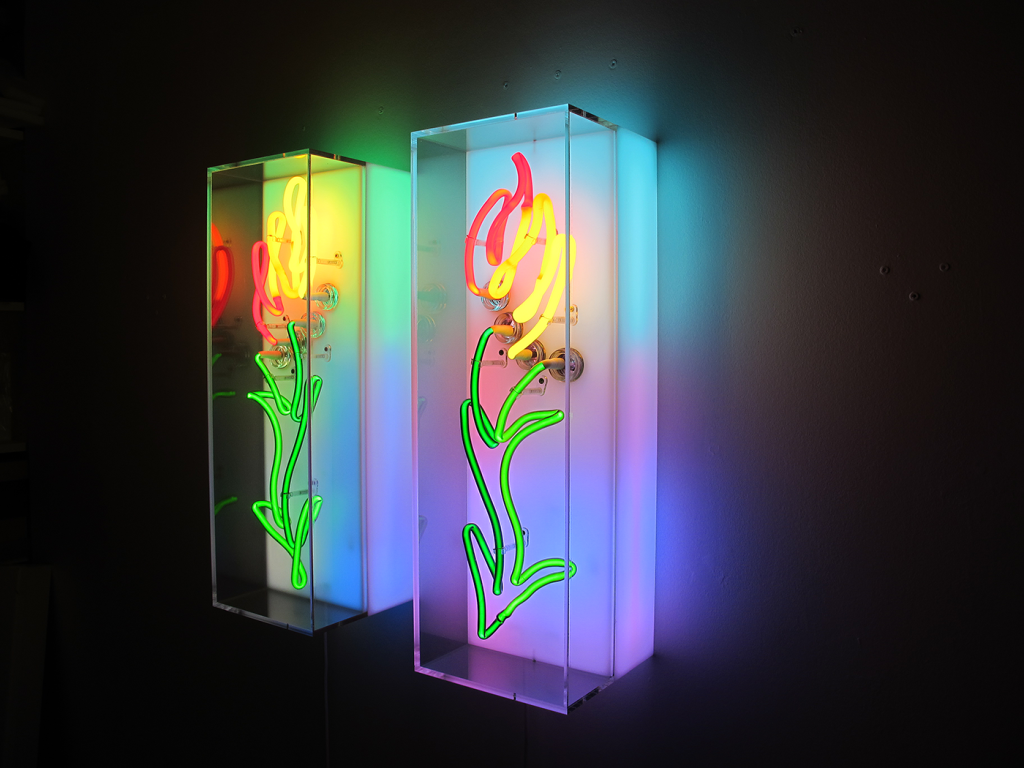
The flower diptych is a bit of an outlier. Here we witness Orest’s combining methodologies: using neon on the front face as “signage” and in back as a “colour field.” Viewing from the side, you can see that he has mounted neon tubes behind the acrylic box to paint the ground. The stylized flower cycles through representations: flame/arrow/flower, and only by comparison do we see the subtle difference in the two blossoms. Rather than pass the GTO wire through the acrylic, he chose surface-mounted spring-loaded glass housing used in commercial neon fabrication for the electrodes, integrating them as an intentional part of the aesthetic/design. They are loud in pitch…but the overall effect is surprisingly elegant. Neon performing its role—to light up the room.
We hope that you enjoy the show.

Orest Tataryn Bio
Orest Tataryn is a light sculptor known for his work with neon. Drawn to the luminous capabilities of neon, his early mandate centered on elevating neon light from the depths of commercialism. Over time he started his own neon shop, neonisoris, and went on to become a founding member of the guerrilla art collective “Skunkworks – Outlaw Neon.” After his early retirement as a fire captain in the city of Toronto in 2003, Orest committed to expanding the boundaries of his practice and was involved in numerous solo and group exhibitions.
Conceptually exploring the relationships between light, colour, and shadow, Tataryn optically and perceptually played with neon tubes in relation to space. This led to him producing many of his colour field studies where he cut and welded different sections of glass to produce patterns. Colour was selected for both its emotional resonance and for its dissonance, which in his words “sparks curiosity.”
Tataryn’s creations are informed by a diverse variety of professional careers and social interests. Experience, collaboration and alliance have informed and guided the development of his studio practice. He is known for his contributions to the fabrication and installation of neon for many contemporary artists, including Kelly Mark, Micah Lexier, Laurel Woodcock, Trush Holmes, Brendan Fernandes, Barbara Steinman, Jaume Plenza and Fiona Banner.
 Collective City
Leave a comment